
Metal Building and Pole Barn Insulation: Types and R-Values
Metal building and pole barn insulation compared: faced blanket, spray foam, rigid board, and foil, with R-value per inch, 2026 cost, and condensation control.
Building cost estimator
Type, size, floor, doors, insulation, finish level, and state in. An itemized low-to-high budget out, with four building types priced side by side.
Insulation in a metal building does two jobs: it slows heat loss, and it keeps moist indoor air off steel that sits at outdoor temperature. The second job is why even unheated pole barns and shops need a plan. This page compares the systems that work on steel and post-frame buildings, with R-values, dated prices, and what each one does about condensation.
Why does a metal building need insulation if it is not heated?
A metal building needs insulation or a condensation barrier even when unheated, because bare steel panels drip. Steel roof panels cool quickly at night, and when warm, moist air inside the building touches a panel colder than the air’s dew point, water condenses on the steel and falls as drips.
That water rots wood purlins and stored hay, rusts fasteners and tools, and stains anything parked below. A concrete slab, wet vehicles, and people breathing all add moisture. Two fixes work:
- Insulation with a vapor retarder keeps warm air away from the cold steel. This is required if the building is heated.
- A condensation-control membrane, such as DripStop, is a fleece applied to the underside of roof panels at the factory. It absorbs condensation and releases it back into the air later. It has no R-value and cannot be added to an existing roof; it is only for unheated buildings at construction or reroofing.
What are the types of metal building insulation?
Six insulation types are used on steel and post-frame buildings. They differ most in R-value per inch, whether they control vapor, and when they can be installed.
| Type | R-value per inch | Installed cost per sq ft | Controls vapor? | Best for | Limits |
|---|---|---|---|---|---|
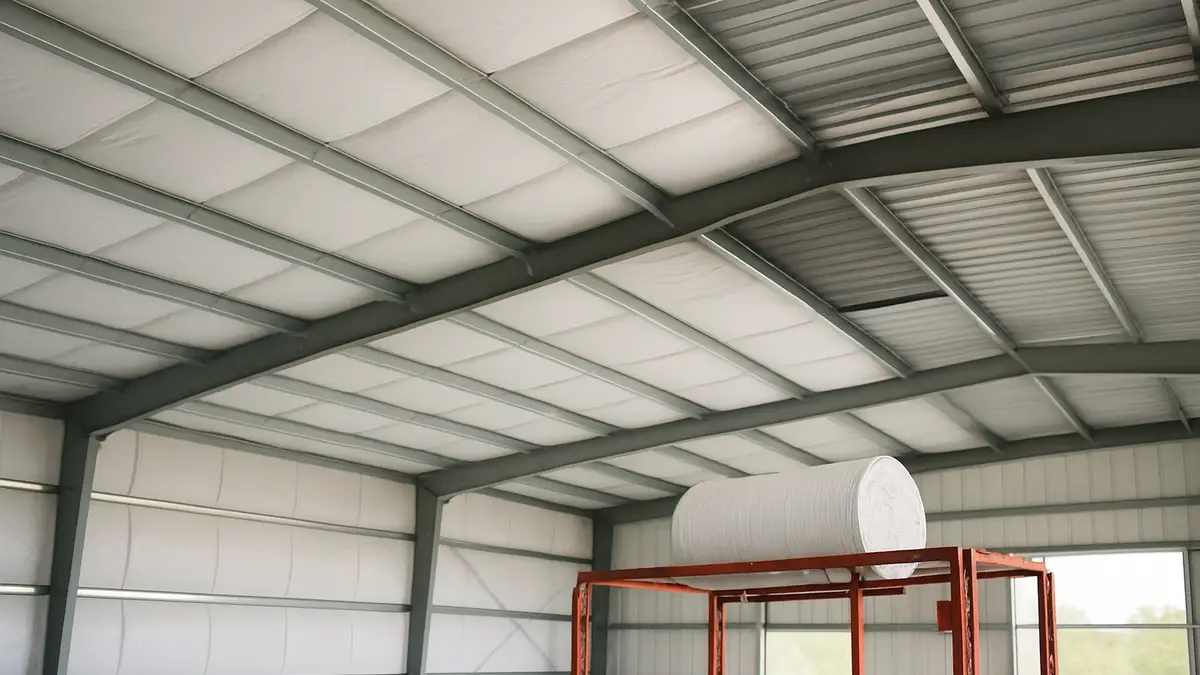
| Vinyl-faced fiberglass blanket | R-2.9 to R-3.8 | $0.50 to $1.00 | Yes, through the facing | New steel and post-frame buildings | Goes in only while panels are off; compresses at purlins |
| Closed-cell spray foam | R-6.5 aged (Armorthane); R-6 to R-8 (Kafafab) | $1.50 to $3.50 (Kafafab); $3.00 to $5.00 at 2 to 3 in (Armorthane) | Yes, Class II at 2 in | Heated shops and barndominiums; retrofits | Pro-only job; needs a thermal barrier in living space |
| Open-cell spray foam | R-3.5 to R-3.9 (Armorthane) | Not priced in our sources | No | Interior walls, sound control | Lets vapor through; wrong choice directly on cold steel without a separate vapor retarder |
| Rigid foam board | R-4 to R-8 | $0.70 to $1.25 | Depends on facing and taped seams | Walls, retrofits, under-slab | More cutting and sealing labor |
| Blown-in loose-fill | R-2.2 to R-3.8 | $0.50 to $1.50 | No | Attics above a flat ceiling | Needs a ceiling to sit on |
| Reflective foil or double bubble | About R-1 to R-1.3 total | $0.15 to $1.50 | Foil itself is a vapor barrier | Hot, sunny climates, as one layer | Little help against winter heat loss |
Costs and R-values are from Kafafab’s metal building insulation comparison (September 2026) unless noted. Prices are installed, per square foot of roof or wall surface, and vary by region and job size.
How much R-value does a metal building or barndominium need?
It depends on what the building is. A storage building has no legal minimum, a heated shop is an owner’s choice, and a barndominium used as a home must meet the energy code adopted where you build.
For homes, the International Energy Conservation Code (IECC) sets prescriptive minimums by climate zone. The 2018 IECC, which many states still use, requires:
| Climate zone | Examples | Ceiling | Wood-frame wall |
|---|---|---|---|
| 1 | South Florida, Hawaii | R-30 | R-13 |
| 2 | Gulf Coast, central and south Texas, most of Florida | R-38 | R-13 |
| 3 | Southeast, Oklahoma, much of the Southwest | R-38 | R-20, or R-13 plus R-5 continuous |
| 4 and 5 | Mid-Atlantic, Ohio Valley, Midwest, interior West | R-49 | R-20, or R-13 plus R-5 continuous |
| 6, 7, 8 | Northern tier, mountains, Alaska | R-49 | R-20 plus R-5, or R-13 plus R-10 continuous |
Newer IECC editions raise the ceiling values, and steel-framed walls use a separate, stricter table (Table R402.2.6 in the 2018 edition), because steel studs and frames conduct heat around cavity insulation. Ask your building department which edition applies. Compliance can also be shown with the US Department of Energy’s free REScheck software instead of the prescriptive table.
One more limit on blanket systems: fiberglass draped over purlins is squeezed flat where the roof panel screws down to each purlin, and compressed fiberglass loses most of its R-value at that line. Liner systems and thermal spacer blocks exist to reduce that loss.
How do you stop condensation in a metal building?
Stop condensation by keeping indoor moisture away from cold steel: a continuous vapor retarder on the warm side of the insulation, sealed at seams and edges, plus insulation thick enough to keep the inner surface above the dew point.
Vapor retarders are rated by permeance, in perms. The IRC classes are:
| Class | Permeance | Examples |
|---|---|---|
| Class I | 0.1 perm or less | Polyethylene sheet, foil facings |
| Class II | Over 0.1 to 1.0 perm | Closed-cell spray foam at about 2 in, some kraft facings |
| Class III | Over 1.0 to 10 perms | Latex paint, some fiber-faced boards |
In buildings heated in winter, the vapor retarder faces the heated interior. That is why faced blanket goes in with the facing toward the inside and its seams taped or stapled closed. Closed-cell spray foam bonds to the steel itself, so there is no gap for moist air to reach the panel.
The vapor retarder only works if it is continuous. Torn facings, open seams at the eave, and unsealed penetrations let moist air reach the steel and drip there anyway.
How is pole barn insulation different from steel building insulation?
Pole barn insulation can use deeper wall cavities and a flat-ceiling attic, which steel buildings usually cannot. Post-frame columns stand 8 to 12 ft apart, and the National Frame Building Association notes the wider spacing allows deeper wall cavities for insulation.
| Post-frame (pole barn) | Red-iron or tube-steel building | |
|---|---|---|
| Walls | Batts or blanket between girts and columns, or spray foam on the panels | Blanket over girts, or spray foam on the panels |
| Roof | Flat ceiling with blown-in attic insulation, or blanket or foam at the roof line | Blanket over purlins, a liner system, or spray foam |
| Cheapest heated option | Flat ceiling plus blown-in loose-fill above it | Faced blanket over purlins and girts at construction |
| Watch out for | Trusses must be ordered rated for a ceiling load | Blanket compression at every purlin and girt |
The flat-ceiling route is often the cheapest way to insulate a pole barn shop or barndominium, but the trusses must be designed for the ceiling’s weight. Order them that way; a truss not rated for a ceiling cannot carry drywall and insulation later. The what is a pole barn guide explains the frame, and the red iron vs tube steel guide explains the steel frames.
Can you insulate a metal building after it is built?
Yes, but the cheapest method is off the table. Faced blanket over purlins goes in between the purlins and the roof panels as the roof goes on, so it cannot be added without removing panels.
Retrofit options, in rough order of cost:
- Liner system: blanket between or below the purlins, held by straps or a fabric liner. Facings made for retrofit work exist, such as Lamtec’s WMP-Retro.
- Rigid foam board fastened to girts and purlins, seams taped.
- Closed-cell spray foam applied directly to the existing panels. It is the most common retrofit for a building that will be heated, and it air-seals at the same time.
- Flat ceiling plus blown-in, in post-frame buildings with trusses rated for a ceiling load.
DripStop-type membranes cannot be added to an existing roof. If an unheated building already drips, spray foam or a liner system is the fix.
Does spray foam need to be covered?
In living space, yes. IRC R316.4 requires foam plastic insulation to be separated from the interior of a home by an approved thermal barrier, such as 1/2 in gypsum board, unless the foam product is tested and approved for exposed use or covered by an approved coating. Exposed spray foam on the walls and roof of a barndominium’s living area will not pass inspection without one of those.
In a detached shop or barn, the rules come from the code your county applies to that building. Ask the building department and the foam installer which coating or barrier, if any, is required.
What does metal building insulation cost?
On a 40x60 building with 14 ft walls, there are about 5,320 sq ft of roof and wall to cover (the roof at a 1.05 pitch factor plus all four walls). At the BarnWise estimator’s October 2026 bands, before any state price adjustment:
| Insulation | Band per sq ft | 40x60x14 total |
|---|---|---|
| Reflective or double bubble | $0.50 to $1.50 | $2,700 to $8,000 |
| Vinyl-faced fiberglass blanket | $0.75 to $1.80 | $4,000 to $9,600 |
| Closed-cell spray foam, 2 to 3 in | $2.00 to $5.00 | $10,600 to $26,600 |
As a cross-check, Steel Building Kit’s July 2026 40x60 breakdown lists blanket insulation for roof and walls at $6,000 to $9,600. The estimator multiplies these bands by your state’s BEA price level and adds them as their own line, so you can see insulation next to the metal building cost, pole barn cost, or barndominium cost totals.
Which insulation should you choose?
Choose by how the building is used, then by budget.
| Building | Good choice | Why |
|---|---|---|
| Unheated storage or equipment barn | Condensation membrane at construction, or faced blanket | Stops drips; heat loss does not matter |
| Shop heated now and then | Faced blanket at construction, spray foam on retrofit | Vapor control plus moderate R-value |
| Heated shop used daily | Closed-cell spray foam, or blanket plus a liner system | Air sealing matters as much as R-value |
| Barndominium or shop house living area | Spray foam or a code-compliant wall and ceiling assembly with a thermal barrier | Must meet the IECC for your climate zone |
| Hot climate, no heating | Faced blanket plus reflective layer with an air space | Radiant layer cuts summer heat gain |
Not covered here: sizing heating and cooling equipment, and electrical work. Those come from a licensed contractor and your local code. For how insulation fits a shop and home under one roof, see the shop house guide.
Where do these numbers come from?
- Insulation types, R-value per inch, and installed costs: Kafafab, “Cheapest Way to Insulate a Metal Building”, September 22, 2026 (kafafab.com).
- Closed-cell spray foam R-6.5 per inch aged, $3.00 to $5.00 per sq ft at 2 to 3 in, Class II at 2 in, and open-cell R-3.5 to R-3.9: Armorthane closed-cell spray foam guide, 2026 (armorthane.com).
- Radiant barriers need an air space; DOE advises against them in cold climates: Wikipedia, “Radiant barrier”, citing the US Department of Energy, read October 2026.
- Vapor retarder classes: IRC definitions as summarized in Wikipedia, “Vapor barrier”, read October 2026.
- IECC prescriptive R-values: 2018 IECC Table R402.1.2 (IRC N1102.1.2), checked on UpCodes, October 2026. Foam thermal barrier: IRC R316.4.
- DripStop description and limits: dripstop.com, read October 2026. Post-frame cavity depth: National Frame Building Association.
- 40x60 blanket cross-check: Steel Building Kit, July 2026 (steelbuildingkit.com).
Frequently asked questions
Quick answers to what buyers and builders ask us most
What is the best insulation for a metal building?
For a heated building, closed-cell spray foam gives the most R-value per inch and air-seals in one step. Vinyl-faced fiberglass blanket is the budget standard for new construction. For an unheated building, a condensation membrane or faced blanket is often enough.
Does a pole barn need a vapor barrier?
If it is heated or insulated, yes. A vapor retarder on the warm side of the insulation keeps indoor moisture from reaching the cold steel. Faced blankets carry one; closed-cell spray foam at 2 in acts as a Class II vapor retarder.
How much does it cost to insulate a 40x60 metal building?
A 40x60 with 14 ft walls has about 5,320 sq ft of roof and wall. At October 2026 bands that is about $4,000 to $9,600 for faced blanket and $10,600 to $26,600 for closed-cell spray foam, before regional price adjustment.
Does double bubble foil insulation work on a metal building?
As a radiant layer in hot climates, somewhat. Kafafab rates foil bubble at about R-1.0 to R-1.3, and radiant barriers need an air space to work. The US Department of Energy advises against relying on them in cold climates.
Can you insulate a metal building after it is built?
Yes, but not with the cheapest method. Blanket over the purlins goes in only while the roof panels are off. Retrofit options are spray foam, a liner system with blanket between the purlins, or rigid board.