
Metal Carport Sizes, Roof Styles, 12 vs 14 Gauge, and Prices
Metal carports start near $1,000 for a single; most two-car units run $3,500 to $7,000 in 2026. Sizes, regular vs vertical roof, 12 vs 14 gauge, certification.
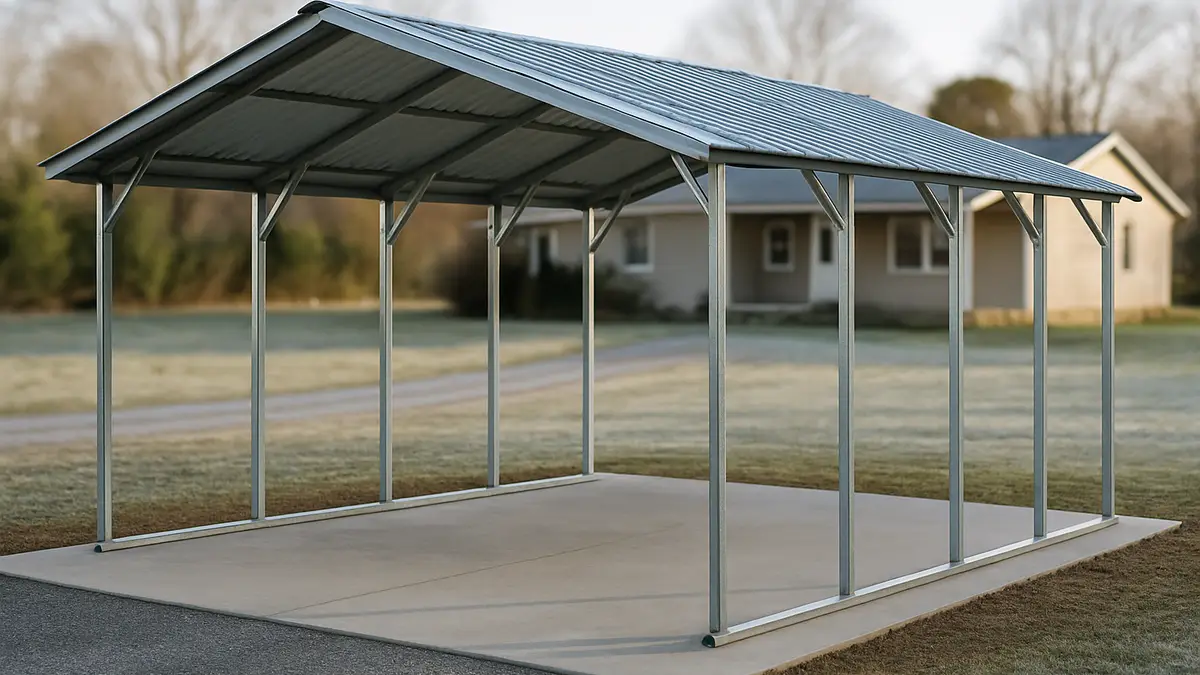
A metal carport is the cheapest steel building you can buy, and the price list is the easy part. The decisions that change what you pay and how long it lasts are the roof style, the tube gauge, whether the frame is certified for the loads at your address, and what the carport sits on. This page covers those four, with dealer list prices read in October 2026.
What is a metal carport?
A metal carport is an open-sided shelter built on a galvanized square-tube steel frame with a corrugated steel roof, usually 29 gauge. The frame is a row of legs and roof trusses (dealers call them bows) bolted to a base rail and anchored to the ground or a slab. It covers vehicles from sun, hail, and snow but has no walls or doors. Aluminum frames are the main alternative; see aluminum vs steel carports.
Carports are sold by dealers such as American Metal Buildings, Carport Central, and Eagle Carports, and the price almost always includes delivery and installation on a site you have cleared and leveled. Carport Central says a typical install takes one day. Once you add walls and roll-up doors, the same frame becomes an enclosed garage, which the metal garage kit guide covers.
What sizes do metal carports come in?
Widths start at 12 ft for one vehicle and run past 30 ft on dealer price lists, and lengths follow the roof panel. Eagle Carports lists its standard roof panel lengths as 21, 26, 31, and up to 36 ft, which is why price lists cluster on those lengths. Legs start at a standard 7 ft at Carport Central and go taller for trucks, campers, and RVs; the RV carport guide covers sizing one from the RV’s spec sheet.
| Size (W x L x leg height) | Typical use | Listed price (October 2026) | Price per sq ft |
|---|---|---|---|
| 12x20 regular roof | One car | From $1,100 (Carport Central) | about $4.60 |
| 20x20x11 | Two cars, tall leg | $3,473 (American Metal Buildings) | $8.68 |
| 24x26x7 A-frame | Two cars or garden storage | $4,026 (AMB) | $6.45 |
| 20x25x12 | Camper | $4,155 (AMB) | $8.31 |
| 26x35x10 | Three vehicles | $9,600 (AMB, read November 2026; $7,932.50 in October) | $10.55 |
| 24x35x12 | Motorhome | $10,200.20 (AMB) | $12.14 |
| 32x50x12 | Large equipment | $21,400 (AMB) | $13.38 |
All AMB prices are listed as varying by location and exclusive of sales tax. Price per sq ft is our division of the list price by the footprint. To see how many vehicles a footprint really holds once doors and walkways are counted, use the metal building sizes guide.
Which carport roof style should you choose?
Choose a vertical roof if you get snow, heavy rain, or the carport is longer than 36 ft; choose a regular roof only for a short carport in a mild climate where price matters most. The three styles use the same tube frame but differ in roof shape and panel direction.
| Roof style | Panel direction | How dealers describe it | Price position |
|---|---|---|---|
| Regular (rounded eave) | Horizontal, front to back | The original carport style; most economical | Cheapest |
| A-frame (boxed eave) | Horizontal | Traditional peaked roofline; uses roofing efficiently | Middle |
| Vertical | Ridge to eave | Slightly stronger; lets snow, leaves, and water slide off | Highest |
When we read Carport Central in October 2026, it said every structure longer than 36 ft must have a vertical roof. Its pages read in November 2026 give no figure and say only that regular and A-frame roofs have maximum sizes, so ask your dealer for the current limit. Steel Building Kit’s modeled July 2026 pricing puts the vertical roof premium at 15 to 25% over a regular roof. American Metal Buildings says vertical panels let snow, leaves, and storm debris slide away; horizontal panels run across the slope instead, which is why dealers steer wet and snowy regions toward the vertical style.
Is 12 gauge or 14 gauge better for a carport?
12 gauge is stronger because the tube wall is thicker, and 14 gauge is the standard frame most carports ship with. American Metal Buildings gives the thicknesses: 14 gauge tubing is 0.0785 in thick in a 2.5 x 2.5 in tube, and 12 gauge is 0.1084 in thick in a 2.25 x 2.25 in tube. That makes the 12 gauge wall about 38% thicker.
| Spec | 14 gauge | 12 gauge |
|---|---|---|
| Wall thickness (AMB) | 0.0785 in (about 2.0 mm) | 0.1084 in (about 2.75 mm) |
| Tube size at AMB | 2.5 x 2.5 in | 2.25 x 2.25 in |
| Status at Carport Central | Standard | Upgrade |
| Added cost | Baseline | About 10% (Steel Building Kit model, July 2026) |
The gauge choice is not a matter of taste. The certified drawings for your address set the gauge, the spacing between bows, and the bracing. As a planning rule, the BarnWise cost estimator flags 12 gauge and closer spacing once ground snow passes 30 psf or design wind passes 140 mph, and warns that tube steel is likely unsuitable above 60 psf or 170 mph.
What does a certified carport mean?
A certified carport has engineering drawings, signed by an engineer, showing that the design withstands stated wind and snow loads. American Metal Buildings defines it that way and lists certified ratings starting at 80 mph wind and 30 psf snow, with options up to 150 to 180 mph. Certified frames add knee braces on every leg, peak braces on the trusses, and extra anchors; stamped, raised-seal plans cost extra.
To know which rating you need, look up your address in the ASCE Hazard Tool (ascehazardtool.org), which reports ASCE 7 ground snow load and basic wind speed. Eagle Carports tells buyers to choose Risk Category I for a carport. Your building department has the final say on the numbers and on whether a permit is needed. Steel Building Kit’s July 2026 model puts certification at 10 to 20% over the base price.
How is a metal carport anchored?
The anchor depends on what the carport sits on, and the dealer brings the matching type. Eagle Carports publishes this breakdown:
| Base surface | Anchor type | Spacing listed by Eagle |
|---|---|---|
| Soil or gravel | Earth auger anchors (double helix) | 10 to 15 ft apart |
| Soil, construction grade | Rebar anchors | 10 ft apart |
| Concrete slab | Concrete wedge anchors | Set about 6 in from the leg |
| Asphalt | Asphalt anchors (four-fin) | 10 to 15 ft apart |
A slab gives the most secure connection and the cleanest floor, but it is a separate contract. At $6 to $12 per sq ft for a 4 in reinforced slab, a 20x20 pad runs about $2,400 to $4,800, which can cost more than the carport on top of it. Certified installations may need more anchors than the base count, so the drawings, not the brochure, set the number.
What does a metal carport cost in total?
Plan on the carport price plus the base and the permit. For a 20x20x11 two-car carport at the $3,473 American Metal Buildings list price (October 2026):
| Line item | Low | High |
|---|---|---|
| Carport, delivered and installed | $3,473 | $3,473 |
| 4 in slab, 400 sq ft at $6 to $12 | $2,400 | $4,800 |
| Permit (accessory structure allowance) | $400 | $2,500 |
| Certification upgrade at 10 to 20% | $350 | $700 |
| Total | about $6,600 | about $11,500 |
A gravel pad instead of a slab cuts the base to roughly $400 to $1,000. Sales tax, grading on a sloped lot, and any electrical are extra. If you might enclose the carport later, Steel Building Kit’s model puts carport-then-enclose for an 18x21 at $8,000 to $14,500 in total, so price an enclosed metal garage up front before you commit.
Who is a metal carport not right for?
A tube-steel carport is the wrong building if you need security, heat, or a heavy-snow rating the dealer cannot certify. It has no walls or doors, so it does not protect tools or a vehicle from theft. Bare steel roofs also drip condensation on cold mornings; the insulation guide explains the fix if you plan to enclose it.
Skip it, too, if your design loads push past what tube frames are certified for. Above roughly 60 psf ground snow or 170 mph wind, look at a red-iron frame or a post-frame building engineered for your address. And check HOA covenants and setback rules before ordering: a carport is a structure, and many subdivisions restrict them.
Frequently asked questions
Quick answers to what buyers and builders ask us most
How much does a metal carport cost?
Dealer list prices in October 2026 start at $995 to $1,100 for a single regular-roof carport. A 20x20 two-car unit lists at $3,473 and a 26x35 triple at $9,600 (up from $7,932.50 in October, read November 2026) at American Metal Buildings, installed, before sales tax and any concrete pad.
Is 12 gauge or 14 gauge better for a carport?
12 gauge tubing is about 38% thicker (0.1084 in versus 0.0785 in) and is the upgrade dealers offer for higher wind and snow ratings. 14 gauge is the standard frame. The certified drawings for your address decide which one you need.
What does a certified carport mean?
A certified carport has engineering drawings signed off for stated wind and snow loads. American Metal Buildings lists certified ratings from 80 mph and 30 psf up to 150 to 180 mph, with knee braces on every leg and extra anchors.
Do I need a permit for a metal carport?
Often, yes. Rules are set by your county or city, so ask the building department before you order. A certified carport with stamped drawings is what most permit offices want to see.
What is the strongest carport roof style?
The vertical roof. Its panels run from ridge to eave, so rain, snow, and debris slide off, and dealers describe it as the strongest of the three styles. In October 2026 Carport Central required a vertical roof on any structure longer than 36 ft; its pages read in November 2026 give no figure, so ask your dealer.