
Steel Gauge Thickness Chart: 7 to 29 Gauge in Inches, mm
14 gauge steel is about 0.0747 in (1.90 mm) as standard sheet; carport tube runs thicker. Full gauge-to-thickness chart and what gauge each building part uses.
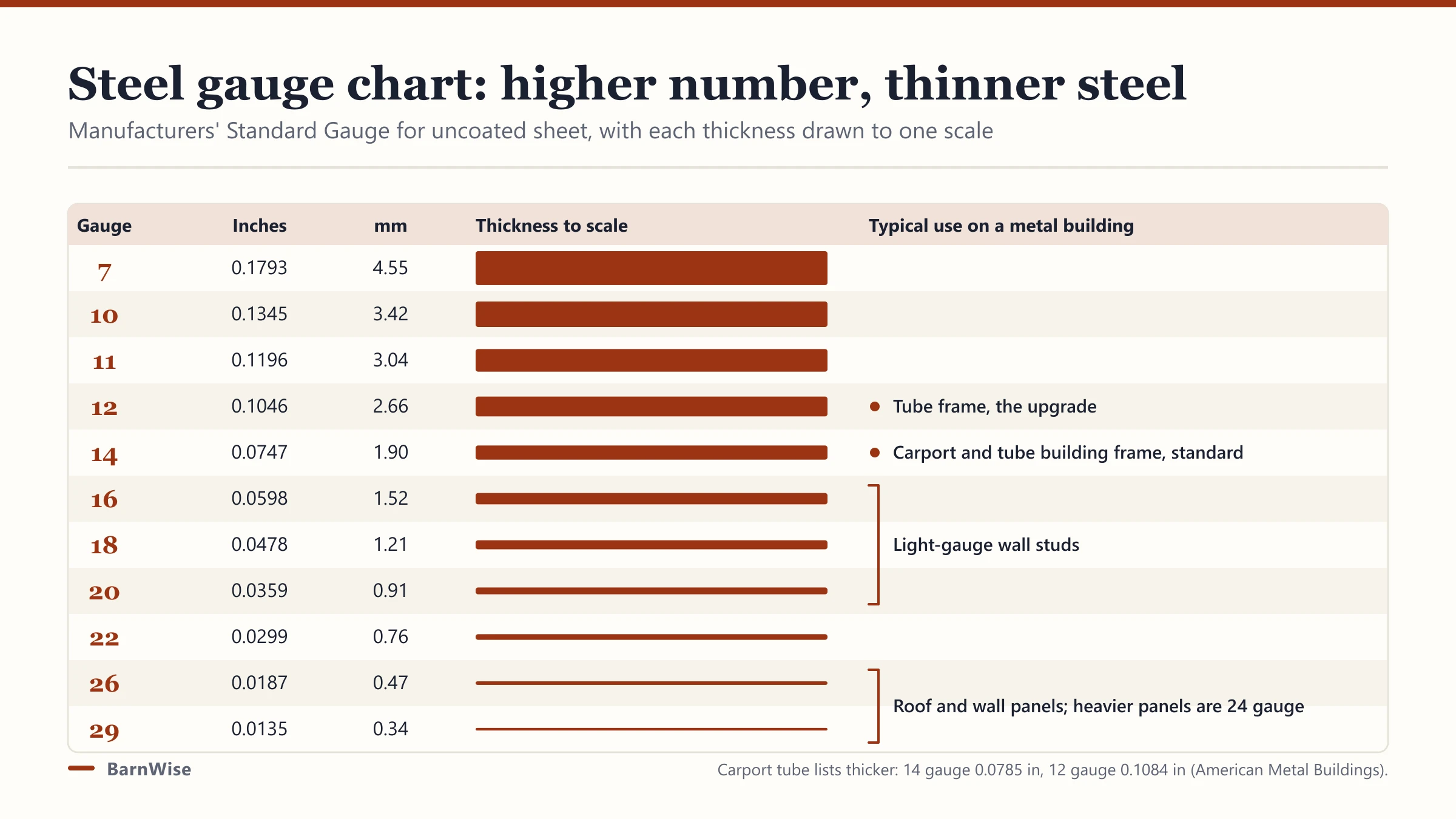
Steel gauge trips up buyers because the numbers run backward and because a carport dealer’s 14 gauge is not the same thickness as a sheet metal shop’s 14 gauge. This page gives the full chart in inches and millimeters, explains why the scale is inverse, and reconciles the sheet standard with the thicker tube numbers building dealers publish, so you can compare quotes that use the word gauge to mean two different things.
What does steel gauge mean?
Steel gauge is a number that describes sheet thickness on an inverse scale: the higher the gauge, the thinner the steel. A 29 gauge roof panel is thin, a 7 gauge plate is thick. The term comes from the old practice of counting how many times a sheet was drawn through rollers to thin it, so more passes meant a higher number.
Because the scale is historical, gauge does not convert to thickness by any simple formula. You read it off a standard table. The most common one for building steel is the Manufacturers’ Standard Gauge for uncoated sheet steel.
Steel gauge thickness chart
This is the Manufacturers’ Standard Gauge for uncoated sheet steel, the table that governs panels and light framing. Millimeters are the decimal inches times 25.4.
| Gauge | Inches | Millimeters |
|---|---|---|
| 7 | 0.1793 | 4.55 |
| 10 | 0.1345 | 3.42 |
| 11 | 0.1196 | 3.04 |
| 12 | 0.1046 | 2.66 |
| 14 | 0.0747 | 1.90 |
| 16 | 0.0598 | 1.52 |
| 18 | 0.0478 | 1.21 |
| 20 | 0.0359 | 0.91 |
| 22 | 0.0299 | 0.76 |
| 26 | 0.0187 | 0.47 |
| 29 | 0.0135 | 0.34 |
Galvanized steel of the same gauge runs a few thousandths of an inch thicker because the zinc coating adds on top of the base metal. For exposed-fastener roof and wall panels, the base metal gauge is what sets the strength.
Why does carport tube list a thicker 14 gauge?
Carport and metal building dealers publish a thicker number for the same gauge because structural tube is measured on a different standard than flat sheet. American Metal Buildings lists its 14 gauge tube at 0.0785 in and its 12 gauge tube at 0.1084 in, both thicker than the sheet chart’s 0.0747 in and 0.1046 in.
| Source | 14 gauge | 12 gauge |
|---|---|---|
| Sheet steel (Manufacturers’ Standard) | 0.0747 in | 0.1046 in |
| Carport tube (American Metal Buildings) | 0.0785 in | 0.1084 in |
The practical point: when you compare two carport or building quotes, ask each dealer the actual wall thickness in inches, not just the gauge number. The metal carports guide covers the 12 versus 14 gauge frame decision in detail, including which loads call for the upgrade.
What gauge does each building part use?
Different parts of a metal building use different gauges, matched to what each one has to carry.
| Part | Typical gauge | Why |
|---|---|---|
| Roof and wall panels | 26 or 29 gauge | Thin, light, carries load through its ribs |
| Heavier panels (snow, impact) | 24 gauge | Stiffer panel for exposed sites |
| Carport and tube building frame | 14 gauge standard, 12 gauge upgrade | Carries the roof and wind loads |
| Light-gauge wall studs | 16 to 20 gauge | Cold-formed framing members |
| Red iron structural frame | Measured in inches, not gauge | Hot-rolled plate and flange |
Panel profile matters as much as gauge for a roof or wall; a deeper rib in 29 gauge can outperform a flatter 26 gauge panel. The metal siding panels guide compares R, PBR, and board and batten profiles and their gauges.
Is thicker steel always better?
No. Thicker steel costs more, weighs more, and is not needed where the load does not call for it. A 29 gauge roof panel on a properly spaced frame sheds snow fine in most of the country; paying for 24 gauge only helps on exposed, high-snow, or hail-prone sites.
The same logic applies to frames. A 14 gauge carport frame is standard and certified for moderate loads, and 12 gauge is the upgrade for higher wind and snow ratings. Buy the gauge the stamped drawings for your address call for, not the thickest one on the price list. The DIY metal building kits guide notes which gauges bolt up easily for an owner.
Why does the same gauge vary in thickness?
Gauge varies because it describes a nominal thickness, not a guaranteed one, and because coated steel adds material on top of the base metal. Three things move the real thickness of a sheet sold as one gauge.
| Cause | Effect on thickness |
|---|---|
| Uncoated vs galvanized | Galvanized runs a few thousandths thicker for the zinc |
| Sheet standard vs tube standard | Tube makers publish thicker numbers for the same gauge |
| Rolling tolerance | Mills work to a tolerance, not an exact number |
That is why a panel labeled 26 gauge from two makers can differ slightly, and why the base metal thickness, not the coated thickness, is the number that sets panel strength. For roofing and siding, the panel profile and the base gauge together decide how far it can span between purlins. When a spec matters, ask for the base metal thickness in inches and the coating weight, such as G90 galvanizing, rather than accepting the gauge number alone.
How does gauge relate to red iron?
It does not, directly. Red iron buildings use hot-rolled structural steel whose members are specified by plate and flange thickness in inches and by section size, not by sheet gauge. Their panels are still gauge-rated sheet, usually 26 gauge, but the frame is a different class of steel.
That is why a red iron building spans wider and carries heavier loads than a tube building of any gauge. The red iron versus tube steel guide compares the two frame systems on span, load, and cost, and the metal garage kits guide shows which gauge frames enclosed garages ship with.
Who should not rely on the gauge number alone?
Gauge is a useful shorthand, but it is not the whole specification in some cases.
- Load-critical buildings. In high-snow or high-wind country, the certified drawings, not the gauge, decide whether a frame is adequate.
- Buyers comparing tube quotes. Two dealers can both say 14 gauge and mean different thicknesses; get the inches in writing.
- Corrosion-exposed sites. Coating weight (galvanizing) matters as much as gauge near the coast or over livestock.
- Readers outside the US. US sheet gauge standards differ from metric steel thickness grades used elsewhere; work in millimeters abroad.
Thickness figures were read from the Manufacturers’ Standard Gauge and American Metal Buildings in October 2026. Confirm the actual thickness and coating on any quote before you compare prices.
Frequently asked questions
Quick answers to what buyers and builders ask us most
How thick is 14 gauge steel?
About 0.0747 in (1.90 mm) for standard uncoated sheet steel on the Manufacturers' Standard Gauge. Carport and metal building dealers publish a thicker number for 14 gauge structural tube: American Metal Buildings lists its 14 gauge tube at 0.0785 in, because tube and sheet gauges are measured on different standards.
Is 12 gauge or 14 gauge steel thicker?
12 gauge is thicker. On the standard sheet chart 12 gauge is 0.1046 in and 14 gauge is 0.0747 in, so 12 gauge is about 40% thicker. For carport tube, American Metal Buildings lists 12 gauge at 0.1084 in against 14 gauge at 0.0785 in, about 38% thicker.
Why is higher gauge thinner?
Gauge originally counted how many times the steel was drawn thinner, so more passes meant a higher number and a thinner sheet. The scale stuck. That is why 29 gauge roof panel is thin and 7 gauge plate is thick, and why the numbers run opposite to intuition.
What gauge steel is used for metal buildings?
Roof and wall panels are usually 26 or 29 gauge, heavier panels 24 gauge. Carport and tube-steel frames are 14 gauge standard or 12 gauge upgraded. Red iron buildings use hot-rolled structural steel measured in inches of plate and flange, not sheet gauge.
How thick is 14 gauge in mm?
About 1.90 mm for standard uncoated sheet steel. The quick conversion is decimal inches times 25.4: 0.0747 in by 25.4 is 1.897 mm. Galvanized 14 gauge runs a few hundredths of a millimeter thicker because of the zinc coating added on top.